During this class I found myself struggling with function machines. I can easily figure out the input and output when given the function machine. I am so glad that Steve showed us how to figure out the function machine for linear functions using the rate of change. Once he showed us that, it got easier for me, and I was able to figure out the function machine every time.
I can tell this class is going to be a little challenging for me, but in my opinion that's a good thing.
Wednesday, March 23, 2011

Wednesday, March 16, 2011
March 16, 2011
Homework Check


What makes something a function?


Sequences: http://www.interactivestuff.org/sums4fun/sequences.html
Terms are built/linked together by multiplication or division and separated by addition and subtraction
Homework
No Reading!
Beckman Hard-Back pg 394 #1 a, &b, #2 a, b, & c
Reflection
How Much do I Weigh?


Algebra is about taking what we know and being able to recognize patterns and describe it. Allows us to open up mathematics.
 |
In this example, we know that a black square would come next, followed by a green triangle. If we assigned letters it would look like this: AA B AA B AA |
 |
Here is another example credit taken by Danae: AA B C AA B C |
What makes something a function?
- an input has one specific output
 |
| Here is an example of a "function machine." 4 goes in for x and a 6 comes out |


Sequences: http://www.interactivestuff.org/sums4fun/sequences.html

 |
| This works with linear functions. |
Terms are built/linked together by multiplication or division and separated by addition and subtraction
- 7x -2
- There are two terms in this problem.
- 1) 7x
- 2) -2

- Another example:

No Reading!
Beckman Hard-Back pg 394 #1 a, &b, #2 a, b, & c
Reflection
Tuesday, March 15, 2011
Reflection
So, after taking the pre test for algebra I have decided that this class is going to be tough for me. It has been a long time since I have done more than basic algebra. I remember learning about slope, x and y intercepts, graphing the functions and inequalities and solving equations, but I don't remember how to do those things let alone teach them. Hopefully it will all come back to me, but this class might be a challenge for me.
The assignment "How Much Do I Weigh" was challenging. I was able to figure out the first page no problem, but really struggled with pages 2 and 3. Is there a trick or a simpler way to do those problems that I am missing? Is there some algebraic expression that I should have picked up on to the those pages less painful? If yes, I'd like to know what I should have done to solve those problems.
The assignment "How Much Do I Weigh" was challenging. I was able to figure out the first page no problem, but really struggled with pages 2 and 3. Is there a trick or a simpler way to do those problems that I am missing? Is there some algebraic expression that I should have picked up on to the those pages less painful? If yes, I'd like to know what I should have done to solve those problems.
Wednesday, March 2, 2011
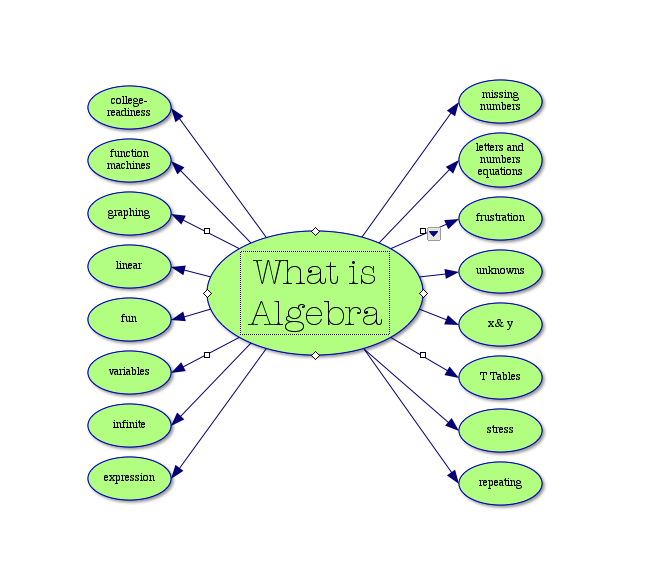
What is Algebra
What is Algebra - a brainstormed list done by the group.
(Screenshots taken from A Maths Dictionary for Kids 2011)
Terms we need to know
Expression

Equation - number sentence with numbers and symbols. You have to have an equal sign, and the problem has to be solvable.

Operation - What you do to the numbers. Add, multiply, subtract, divide
Variable - sumbol that represents the unknown. Usually a letter, in lower grades its a box, shape or line. Example - 5x (x is the variable)
Constant - Doesn't change. A 3 is always a 3, 5 is always a 5

Inequality - not equal in size, amount or value

Function - For each input, there is one output.

Order of Operations


Homework:
Read 254 - 256 in Van de Wall
Problems on the worksheets
1/2 gal cardboard - start collecting
Wednesday, February 16, 2011
February 16, 2011
Chinese Method of Multiplying


 |
| These are problems Teresa shared in class |
Unit Rate and Scale Factor

Unit Rate is always talking about change in rate of a unit. Change per one unit of measurement.
Scale Factor - if you know how much 2 gallons of gas is you can figure out how much 10 gallons of gas are.
Indirect Variation - not proportional


Percentages -
25% of $100,000 = $75,000 - so, a loss of $25,000. This is based off the amount I started with $100,000. To increase $75,000 to $100,000 it's NOT and 25% increase it is a 33% increase because you are increasing from the amount started with $75,000.

Review for test
Wednesday, February 9, 2011
Ratios
Van de wall pg. 351 - problem about the flowers growing 3 inches.
Math Snacks Video - Bad Date - great explanation about ratios
Strip Model
(Beckmen softback book) Class activity 7 B
Double Number Line
Finding lengths using ratios/proportions.

Similar objects

aaa.study.com
Math Snacks Video - Bad Date - great explanation about ratios
Strip Model
(Beckmen softback book) Class activity 7 B
Double Number Line
- Can make quick comparisons using double numberline


Finding lengths using ratios/proportions.


If you Hopped Like a Frog
 | ||||||||
| There are problems at the end of the book that are great for students to do. |
Brian Greene says math is the gateway to reality and calls Stephen a bag of particles governed by the laws of physics. (05:58)
| The Colbert Report | Mon - Thurs 11:30pm / 10:30c | |||
| Brian Greene | ||||
| ||||
Wednesday, February 2, 2011
Reflection for Jan. 26th Class
I really enjoyed trying to figure out how to model dividing fractions. This is a tough topic for me to really "grasp". I still feel like I would have a difficult time explaining the "why" to students. I liked the example I was able to find online....I posted the PowerPoint slides on my blog. This example made sense, until we had to work on a more difficult problem and then suddenly I was lost again. My question is, would I really want to explain this to students? I worry that explaining it would confuse the students.
Subscribe to:
Posts (Atom)