Wednesday, October 27, 2010

October 27

Real numbers are all numbers, the number system. Both rational and irrational
Rational numbers are numbers that can be written as fractions and decimals
Irrational numbers - numbers that you cannot find a perfect square of. "pie" is an irrational number, numbers that keep repeating
Natural numbers - the counting number not including zero,
Whole numbers - counting numbers including zero, don't include negative numbers
Integers - negative numbers, positive numbers and zero.  NOT including fractions and decimals.


3 - real, rational, integer, natural

-3 - integer, rational, real

3.33 - rational, real

1/2 - rational, real

√7 - irrational, real

pie - irrational and real

√25 - natural, whole, integer, rational, real

9/3 - natural, whole, integer, rational, real

√16/4 - natural, whole, integer, rational, real

43 - natural, whole, integer, rational, real
e - irrational, real

Number Bonds

Addition is always part plus part equals whole
Subtraction is whole minus part to find the other part

Multiplying Integers

negative x negative = positive
positive x positive = positive
positive x negative = negative
negative x positive = negative

The first statement is the who  The second is the action (what happened)  and the = is the result.
example:
  1. Mother Teresa wins the lottery = a good thing ( + x + = +)
  2. Mother Teresa gets mugged = a bad thing  (+ x -- = --)
  3. The Devil wins the lottery = a bad thing (-- x + = --)
  4. The Devil gets mugged = a good thing (-- x -- = +)
positive - Eric Bana
action - wins an oscar
negative - Lindsay Lohan
negative action - bad accident and gets deformed
  1. Eric Bana wins an oscar = a good thing - he gets more movie opportunities  (+ x + = +)
  2. Eric Bana gets in a horrible car crash and gets deformed =  a bad thing no more acting career for Eric Bana  (+ x -- = -)
  3. Lindsay Lohan wins an oscar = a bad thing - Why on earth would she win an oscar?  She's a horrible actress (-- x + = --)
  4. Lindsay Lohan gets in a horrible car crash and gets deformed = a good thing - she can get out of the spotlight and rebuild her life. (-- x -- = +)
Distributive Property
Trichotomy - there are three relationship 2 integers can have and only three.  
  1. negative < 
  2. less than > 
  3. equal to =

This is a transitivity statement;  a = b  b = c => a = c  
                                                6 < 8,  8 < 10 =>  6 <10


Tuesday, October 26, 2010

October 20 Reflection

I really liked the explanation for why a negative times a negative is a positive.  I remember getting this question from students and not being able to give them a good answer/explanation.  I like the explanation that Steve gave about positives and negatives using the example of money.  That is a great way to share w/students because money is an example they can relate to.   I like the idea of using the example, "If you take something bad away from you its "good".

October 20, 2010

What have we learned?  Things to make sure I am familiar with for the content test at the end of this class....

  • Part Part Whole -
  • Commutative Propery
  • Associative Property
  • Distributive Property
  • Identity Property
  • Zero Property
  • Concrete - Representational - Abstract
  • Set/Measurement Models
  • Base Ten
    • Standard
    • Expanded
    • Word
    • Shortened
    • One to one correspondent
  • Terminology
    • "Nice" numbers
    • Regrouping
  • Inverse operation
  • Operations
    • +
    • -
    • x
    • divide
  • Hops, jumps, skip counting
  • Array
  • Area
  • Compensation Method
  • Algorithm
  • Minuend
  • Addened
  • Difference
  • Factor
  • Sum
  • Product
  • Compatable numbers
  • Rounding
  • Estimating
  • Shortened form
  • Partitive
  • Quotative
Integers

  • We started with counting, then there is zero, and then progressed to Integers which includes negative numbers. 
  • The number line is a tool kids should be familiar with.
    • Where do the negative integers start?  With -1, don't include the fractions that fall between zero and 1. 
  • Less than - numbers to the left of that number on number line

  • Greater than - numbers to the right of that number on the number line

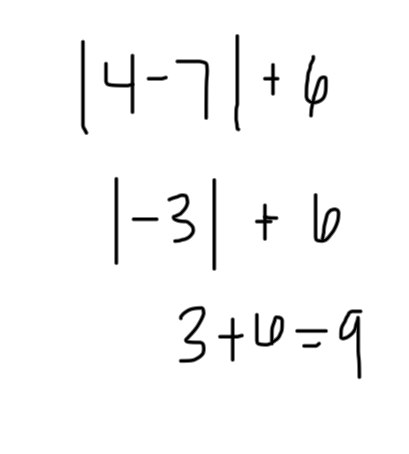
  • Absolute Value - how far a number is from Zero 


      • The point of absolute value is distance, and is used in physics
    • Opposites - relationship between numbers that make the whole number Zero.


      Addition = Part + Part = Whole
      Subtraction = Whole - Part = Part


      Readings for Next Week
      Van de Wall pgs 479 - 481 - Integers 481 - 486 (problems - look at them)
      Parker - pgs 185 - 189


      Wednesday, October 20, 2010

      October 12th Reflection

      I feel like I didn't get very much from last weeks class.  Part of the is my fault, since I was late coming to class.  I feel like each week I leave with different strategies for teaching that particular different, and this week I left knowing about the scaffolding method for divison and the lattice mathod for multiplication.  I really liked learning the scaffolding method, I have never seen that before and can see how that could help some students with the whole division process.  I thought it was funny how long we spent talking about the different ways to remember the steps to division, Multiply, Divide, Subtract, Bring Down.  Some teachers are very creative, I was boring when I taught this to my students.  I just had a poster I created that was on my whiteboard and as we solved the division problem we would put a check mark next to each step as we finished it. 

      Was there more I should have gotten from last week's class? 

      October 12, 2010

      Division

      Help students remember the division process - D, M, S, B - Divide Multiply Subtract, Bring Down

      Ideas to show students how to divide by zero and why it doesn't work

      • show an equation
      • give students a word problem
      Scaffolding Method

      The Lattice Multiplication Method
      The answer is 64,470


      Tuesday, October 12, 2010

      October 6 Reflection - Better Late than Never Right?

      So, I didn't do my reflection until just now but to be honest I didn't really know what to write after that class.  I feel better about the break it up strategy.  I think as a teacher I would present these different math strategies and let the students decide what works best for them.  I am not satisfied with students just getting the right answer, I like to know that students know HOW to get to the right answer.  I think it is important to show students that there are multiple ways to get to an answer.  I was always taught to solve problems using one method, and I think I would have done better in math had I been shown different strategies.

      Wednesday, October 6, 2010

      October 6, 2010

      Grid Multiplication Model:


      Multiplication Facts

      • As math gets more challenging, kids need to make sure they know their math facts or they won't be able to move on.
      • Kids can't go back in mathematics
      • There is forced progression in math, THEY NEED TO KNOW THEIR MULTIPLICATION FACTS
      Multiplication Fact Strategies
      • 9 = 10 take away 1 
        • 9 x 4 = 10 x 4 = 40 then take away one group of 4 40 - 4 = 36
      • 2 = double
        • 4 x 2 = (4 + 4 = 8)
      • 3 = skip counting
      • 4 = double, double
        • 4 x4 = (4 +4 +4 +4 = 8 + 8 = 16)
      • 5 = skip counting, there is a pattern
      • 6 = 5 plus 1
        • 6 x 5 = (5 x5 = 25 + 5 = 30)
      • 7 = skip counting
      • 8 = double, double, double
      • 12 = ten plus 2s 
        • 12 x 2 = (10 x 2 = 20 +2 + 2 = 24)
      Lesson Study
      • Launch - how are you going to prep those kids for the lesson
        • What are the guiding questions?  Get the students talking.
        • Anticipatory set - where students may make mistakes
        • Interventions - how can you respond to the student errors
      • Exploration
        • What are the guided questions
        • Anticipatory set
        • Interventions
      • Wrap Up/Classroom Discussion
        • What are the guided questions
        • Anticipatory set
        • Interventions
      • Assessment Piece
      Readings for Next Week:

      • Beckman p 115 Activity 6B #1-2
      • Beckman reading 234 - 235
      • Van de Wall pg 155